
Focus your energy where failure would hurt the most (Part 1)
Build the System in the Order the Mission Needs It
This is the first in a three-part series about focusing your energy where failure would hurt the most. The series explores how to choose what deserves attention now, scale process to risk, and solve the problem beneath the problems.
Most organizations don’t have a shortage of things to improve. There are processes that need clarification, tools that do not quite work, problems that never seem fully resolved, decisions that keep getting revisited, and important work that still depends on the one person who “just knows.”
When everything appears to need attention, the natural response is often to begin with whatever feels manageable. You close a few straightforward actions and create enough visible movement to feel like progress is being made. Small improvements matter, and sometimes a few quick wins are exactly what a team needs.
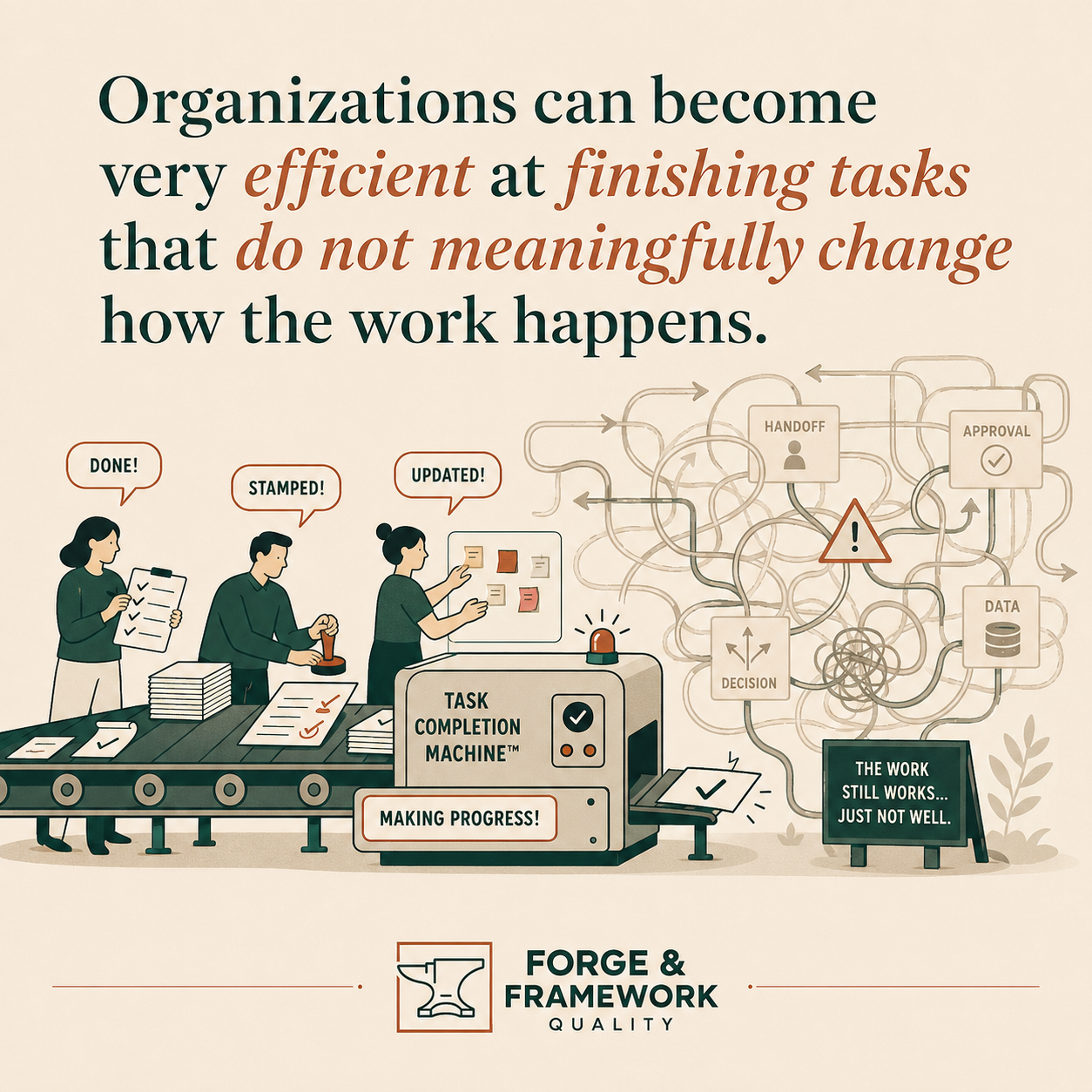
But completing the easiest work is not always the same as strengthening the system. Organizations can become very efficient at finishing tasks that do not meaningfully change how the work happens.
Sometimes the most valuable thing an organization can do is stop trying to fix everything at once and become much more deliberate about where it begins.
Every problem may deserve eventual attention. Not every problem deserves equal attention at the same time.
Start With the Problem That Matters Most
There is familiar productivity advice that says to “eat the frog” by completing the hardest or most unpleasant task first. There is wisdom in that, especially when avoidance is the main obstacle.
Building a business system requires slightly different thinking: Don’t necessarily start with the task you dread most. Start with the weakness that matters most.
The hardest task and the most important problem may be the same, but they are not always. A difficult project can consume enormous energy without improving anything essential, while a relatively simple change can sometimes remove friction from an entire process.
The goal is not to prove that the organization can do hard things. It is to direct limited attention toward the work that will make the greatest difference.
A useful way to choose is to look for the intersection of three things:
Severity: Where would failure most seriously affect the mission, the customer, the product, the people doing the work, or the organization’s ability to deliver?
Repetition: What problem keeps returning, consuming attention, or requiring the same workarounds?
Leverage: What improvement could reduce several surrounding problems or strengthen the organization’s ability to solve future ones?
The most valuable place to begin is often where consequence, recurrence, and leverage meet.
The Priority Depends on the System
When I begin developing a quality system in an organization, there are usually many visible gaps I can address first: training records, supplier oversight, documented processes, and more consistent controls. I usually start with a different system each time.
For one company, the most damaging weakness was not a missing document. It was that problems were repeatedly surrounded with temporary fixes and then allowed to return.
People were skilled at restoring the work, protecting the deadline, and moving forward. That resourcefulness mattered, but the learning often stopped once the immediate pressure disappeared. Similar failures kept returning because there was no reliable path from response to root cause, ownership, and prevention.
That made corrective action one of the most valuable places to begin - not because it came first in a standard, but because a little more structure there could create unusual leverage. A stronger process helped the organization recognize patterns, address underlying causes, and carry learning from one problem into the rest of the business.
In another organization, incoming inspection was the right starting point because purchased materials had historically caused many of the failures. Somewhere else, that same level of inspection might add little value because the greater risks live in design, project startup, manufacturing, installation, or field use.
The right starting point was different because the system was different.
Standards and templates can show what a healthy system might include, but they cannot tell you where your organization is most vulnerable. Your own operating history can.
Where do problems keep returning? Where do teams repeatedly lose time or information? Where does success depend on someone remembering what to do? Where could one improvement prevent several others?
Those questions reveal where structure will create the greatest leverage - and where your system should begin.
Build the System in the Order the Mission Needs It
When the improvement list is long, it is tempting to spread attention across all of it. A little work goes toward supplier management, a little toward project planning, a little toward training, and a little toward document control.
Everyone stays busy, but none of the important problems receives enough sustained attention to be solved.
An improvement list is not a strategy. It is only an inventory of things that could be better.
A deliberately short priority list forces the organization to distinguish between what should eventually improve and what deserves focused attention now. Three meaningful priorities are often enough—not three departments or broad goals such as “improve communication,” but three problems the organization can understand, investigate, and begin resolving.
Use consequence, recurrence, and leverage to choose them. Which failure would cause the most harm? Which problem keeps returning? Which improvement could make several other parts of the work easier?
Then choose.
Real focus requires permission to sequence the work. It means being able to say, “Yes, that matters, but it is not the first thing we are solving.” That is not neglect. It is strategy.
A healthy system can keep other risks visible, maintain a backlog, and revisit priorities without pretending that every issue is urgent. That honesty is far more useful than allowing the loudest problem of the day to set the agenda.
Do not build the QMS in the order a standard is written, a template is organized, or an auditor may eventually review it. Build it in the order the mission needs it.
Start where failure would hurt the most. Give that problem enough attention to create meaningful change, then use what you learn to decide what comes next.
You do not need to fix everything at once, and the system does not need to be complete before it becomes useful. A strong QMS can grow from the places where better clarity, ownership, and learning will make the greatest difference.
That is how process begins serving the work instead of becoming one more burden placed on top of it.
A completed task creates movement. A solved system problem creates capacity.