
The Tool Isn’t the System
We’ve all been there…
A team rolls out a shiny new project management app with the quiet hope that this will be the thing that finally makes the work feel organized.
The dashboards look promising. The automations are clever. The templates are loaded.
Everyone attends the training, agrees that the new tool seems useful, and walks away with the sense that maybe this time, things will run more smoothly.
Then two weeks pass, and things are as chaotic as they were at the beginning.
That is usually the moment when people start blaming adoption. Maybe the team needs more training? Maybe people are resisting change? Maybe we need another dashboard, another workflow, another reminder?
Sometimes those things are true. But often, the real problem is much more basic:
The tool was never the system.
The tool was only a place where the absence of a system became visible.
Tools Cannot Answer System Questions
There is a quiet misunderstanding at the heart of many well-intentioned improvement efforts: we think the tool is the system.
A SharePoint site becomes “the QMS.” A PLM platform becomes “configuration management.” A project management app becomes “how we manage projects.”
But a tool is not a system. The system is the operating logic of the business.
The system is how people know what matters, what comes next, who owns the decision, what information is needed at each handoff, and how problems move from discovery to resolution. It is what keeps work from depending on memory, heroics, side conversations, or the one person who “just knows how things work.”
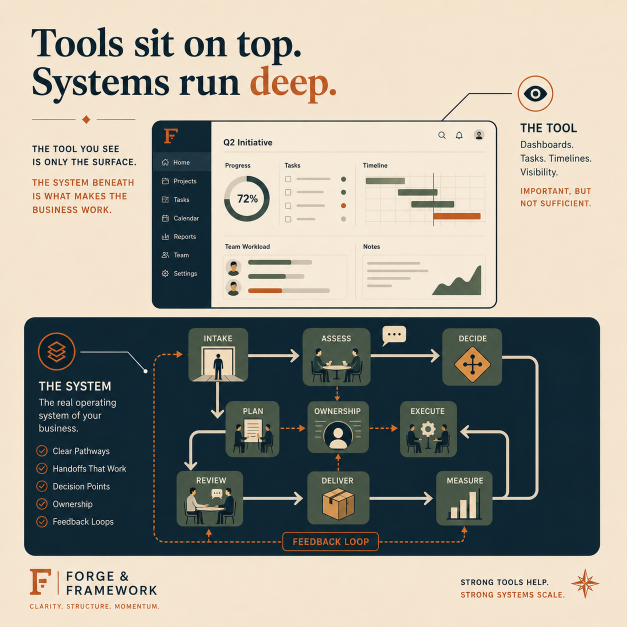
A good system is what makes the business run with less friction. It prevents fire drills by making expectations clear before work begins. It helps teams understand what “ready” means, what “done” means, and what needs to happen when something changes. It gives people enough structure to do their best work without forcing them to reinvent the path every time.
A tool can support that system. It can make the process easier to see, use, repeat, and sustain. It can reduce administrative burden, create helpful reminders, and give leaders better visibility into what is happening.
But it cannot create the system.
That is why so many organizations invest in tools and still feel stuck. The platform is technically working. The dashboard is technically displaying data. The workflow is technically configured. But people are still trying to reverse-engineer the process from fields, permissions, templates, and status options.
That is not sustainable, and it is not fair to the people doing the work.
A tool should not ask people to guess the process. It should support a way of working that has already been made clear.
The tool may hold the records, but the system is what makes the records meaningful. Without that system, even the best tool becomes one more thing people have to feed.
Tools do not create systems.
They reveal them.
And sometimes what they reveal is that the system was never really designed in the first place.
The Best Systems Often Start Simply
Some of the best systems I have seen did not start with software at all - they started with with one added bit of clarity.
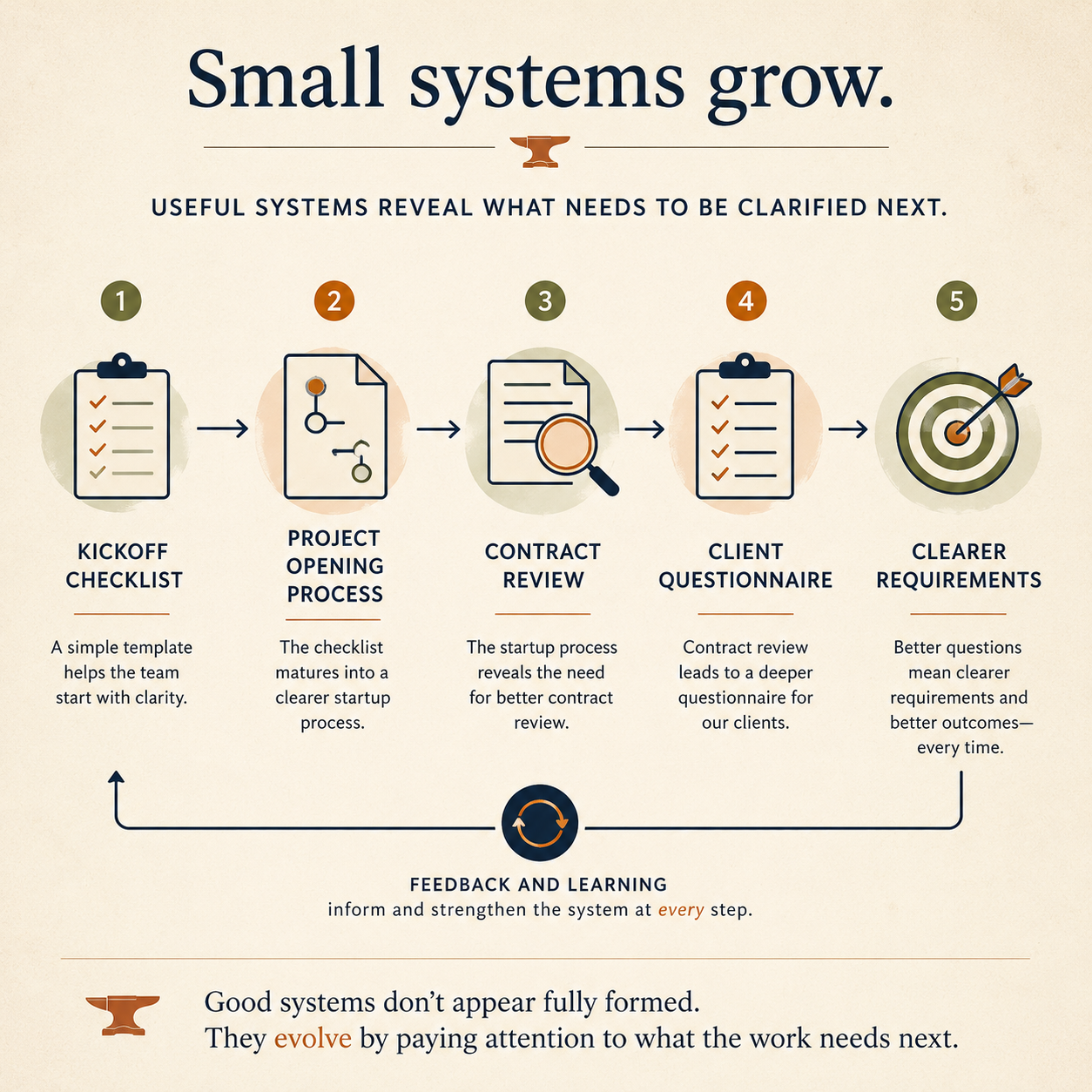
I remember seeing the early shape of a project system emerge from something as simple as a kickoff meeting template. It wasn’t flashy and it didn’t have a beautiful interface. It was not a complete end-to-end workflow. It was just a practical way to make sure the right things were discussed before the work started.
Do we have the right charge codes? Are the security requirements clear? Do we understand the customer requirements? Do we know who owns what? Are there constraints, risks, assumptions, or handoffs that need to be visible before the team begins? Who is accountable for what?
That kind of template may seem small, but it does something powerful: it creates shared attention. It says, “Before we rush into action mode, let’s make sure we understand what matters most.”
Over time, that simple structure can mature. The kickoff template later became a clearer project opening process. The project startup process revealed that we needed a better contract review to inform the startup meetings. The contract review process helped us to make an in-depth questionnaire for our clients that let us get clearer requirements and a better understanding of what was important to the customer every time.
Eventually, what began as a simple checklist becomes the backbone of how work moves.
That is the system.
Not because it is complicated, but because it creates a reliable path through complexity.
Design the System Before You Choose the Tool
There is nothing wrong with good tools - a well-chosen tool can save time, reduce friction, improve visibility, and make a system easier to sustain. But tools are most powerful when they are supporting something real.
That is why a Mission-Driven QMS starts with system design, not tool selection. Before asking, “What software should we use?” it asks better questions: What does our mission require from the way we work? Who owns what? Where do handoffs break down? What decisions need to be controlled? How does learning flow back into the system?
Those questions define the real architecture of the system. Once that architecture exists, the tool choice often becomes simpler. You are no longer shopping for software to magically create discipline. You are looking for a tool that supports the way your organization actually needs to work.
When a tool is added before the system exists, it becomes a substitute for thinking. Teams are left trying to reverse-engineer intent from workflows, forms, permissions, and required fields. That is when tools start to feel heavy - not because the tool is necessarily bad, but because the organization is asking it to carry something it was never meant to carry.
So before chasing the next platform, pause and ask whether the system is clear enough to exist outside the tool.
Would the system still make sense if you had to run it on a whiteboard for a week?
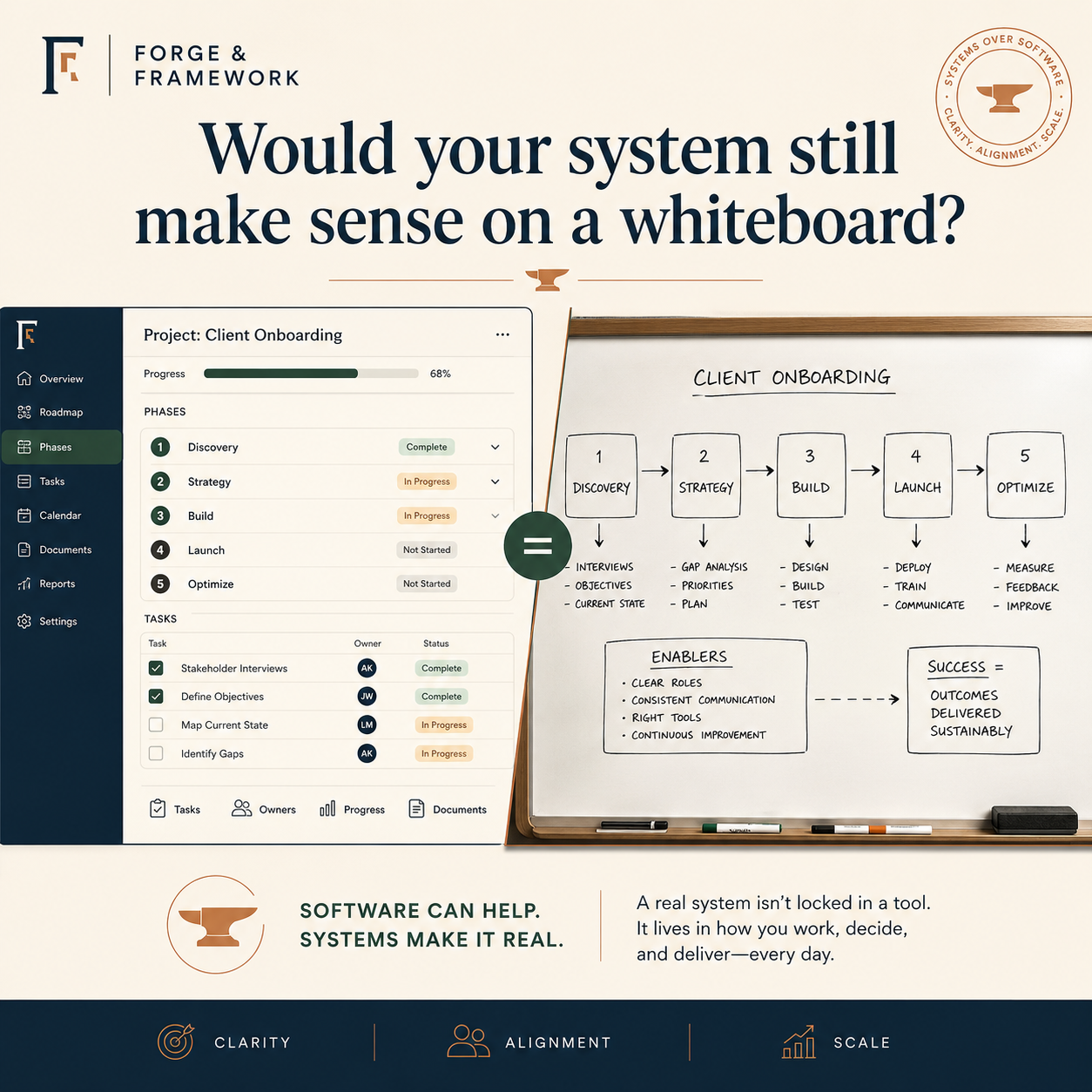
That question cuts through the noise. If the system would collapse without the software, the tool may be carrying too much. But if people could still understand the flow, ownership, decision points, and handoffs without it, then the tool has something solid to support.
The system comes first. The tool comes second.
Once that clarity is in place, the tool can finally do what it was meant to do.
Not replace the system.
Amplify it.
And when that happens, the organization stops asking software to create clarity and starts using it to sustain the clarity it has already built.
That is where real quality begins.