Why Quality Should Serve the Mission - Not the Other Way Around
When people hear the word “quality,” they often picture paperwork: procedures, audits, forms, training records, corrective actions, and document libraries that no one really wants to open unless an auditor is coming.
And honestly, I understand why.
In too many organizations, quality has become something separate from the work itself. It sits off to the side of the business, watching, checking, correcting, and occasionally stopping everything in the name of compliance. The intention may be good. The people may care deeply. The requirements may be real. But somewhere along the way, the system gets turned inside out. Instead of helping the business deliver on its mission, the business starts bending itself around the quality system.
That is where quality loses its way.
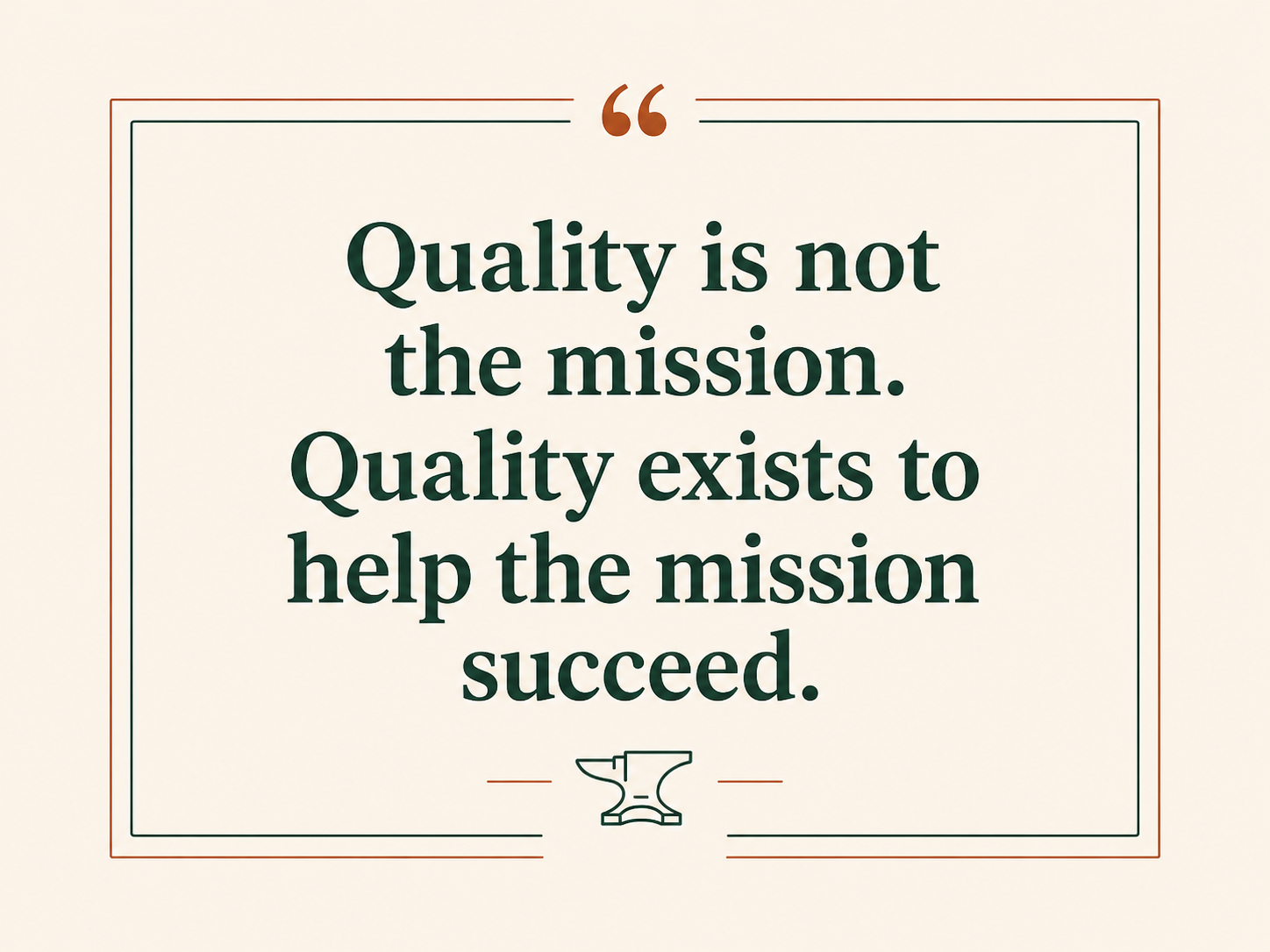
Quality is not the mission. Quality exists to help the mission succeed.
That distinction matters because it changes the purpose of the entire system. A Quality Management System should not be a paperwork machine, a compliance performance, or a structure that makes the quality team feel important. A real QMS should be a business system. It should help the organization understand what matters, reduce confusion, manage risk, learn from problems, and make good work more repeatable.
At its best, quality is not about controlling the business. It is about helping the business become worthy of its mission.
When Quality becomes the Point
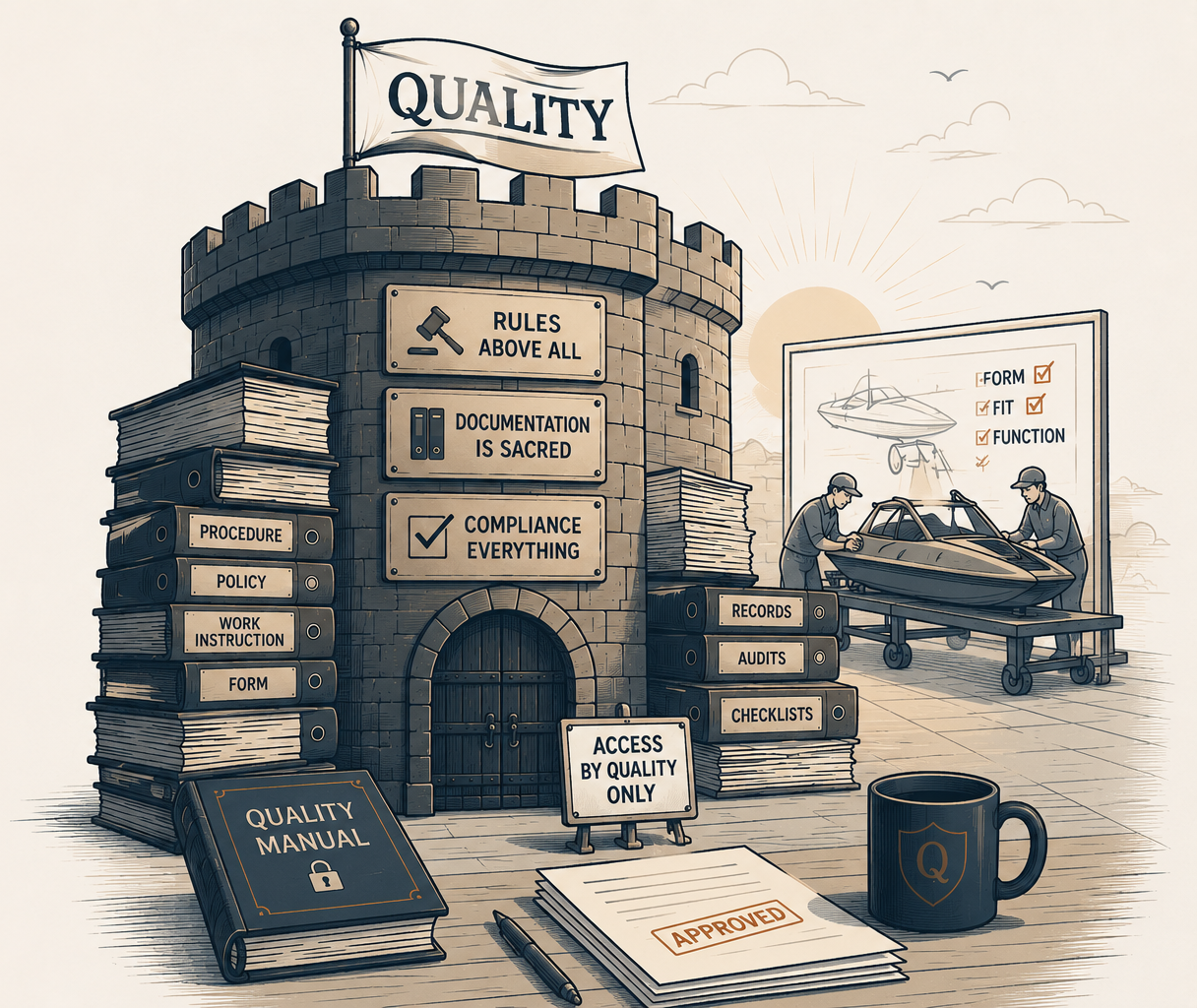
I have seen quality systems where the quality function seems to believe it is the most important part of the business. The rules become rigid. The documentation becomes sacred. The technicalities start to matter more than the actual form, fit, and function of the products being delivered. When documentation becomes more important than the work it is supposed to support, people notice. Engineering starts to see quality as an obstacle to progress. Manufacturing starts to see quality as the enemy of getting things done. Leaders start to see quality as overhead. And perhaps most damaging of all, people start hiding problems.
Most of the time, people do not hide problems because they are careless or irresponsible. They hide problems because admitting a mistake means stepping into a paperwork exercise that feels disconnected from the real work of fixing the issue, protecting the customer, and moving the mission forward. If every problem becomes a bureaucratic ordeal, people will naturally learn to avoid the system.
That is not a healthy quality culture. It is not continuous improvement. And it is certainly not a true Quality Management System.
A system that teaches people to hide problems is not managing quality. It is managing appearances.
A QMS Should Be a Business System
A Quality Management System should exist to help the business work better. It should clarify processes, define ownership, make expectations visible, and ensure that people have the tools and information they need to do excellent work. It should create a shared understanding of how work moves through the organization and how the team responds when something does not go as planned.
That is why I believe quality has to be understood as a business system.
A business system is more than the official process map. It is the way work actually happens. It includes procedures, records, tools, reviews, metrics, inspections, audits, and corrective actions, but it also includes trust, ownership, communication, incentives, leadership behavior, and the way people respond when something goes wrong.
If the written system says, “Report problems,” but the lived system says, “Reporting problems will make your life harder,” the lived system wins every time.
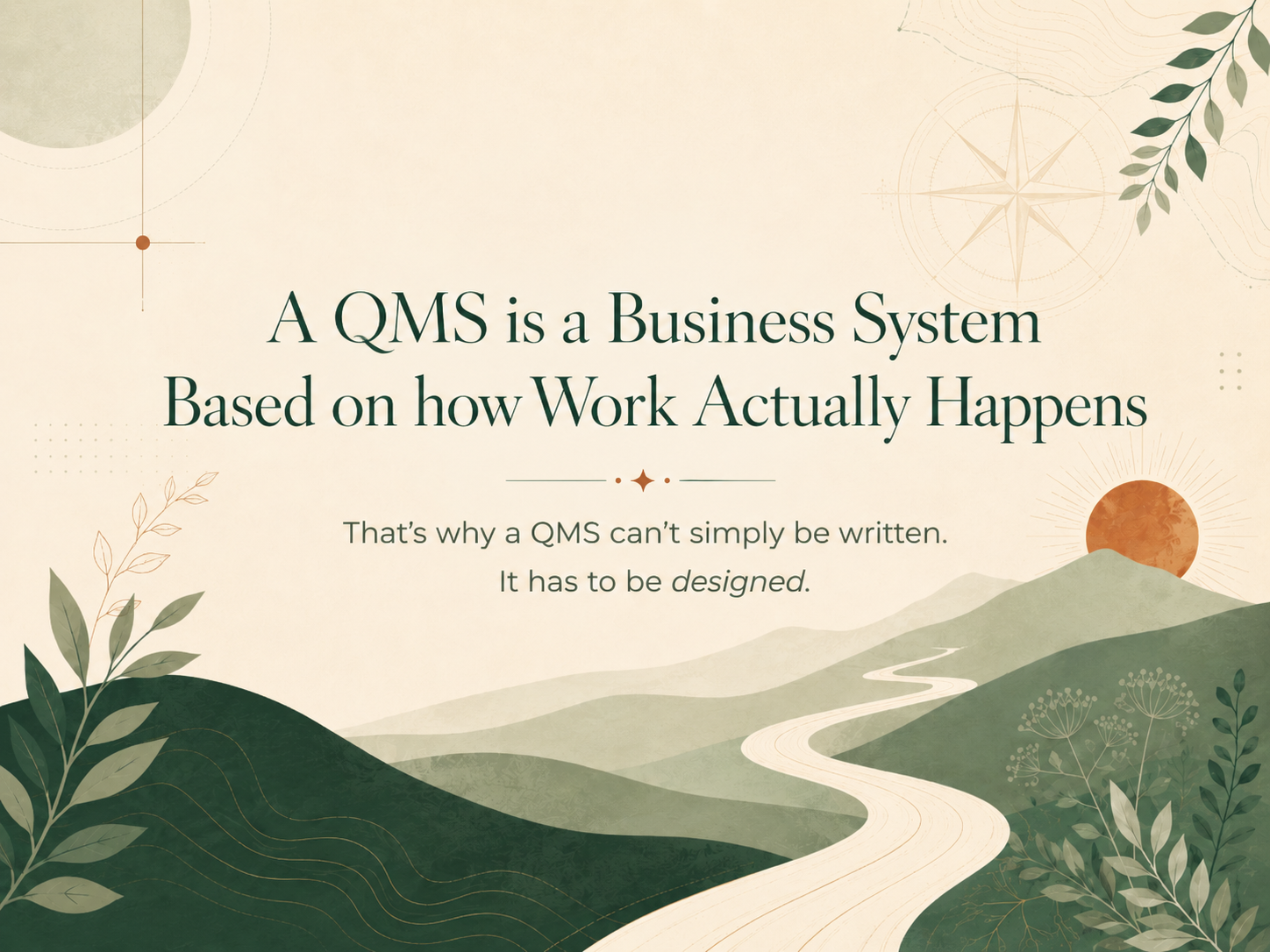
That is why a QMS cannot simply be written. It has to be designed. And it has to be designed for real humans: people working under deadlines, with imperfect information, competing priorities, customer pressure, production pressure, engineering complexity, and the very normal desire not to make their own day harder than it already is.
If the quality system ignores that reality, people will work around it. If the quality system respects that reality, people may actually use it.
The Mission-Driven QMS
This is the idea behind a Mission-Driven QMS.
A Mission-Driven QMS starts with the work the organization is actually here to do. What are we trying to deliver? Who depends on it? What has to go right? Where would failure hurt the most? What do our people need in order to do excellent work consistently?
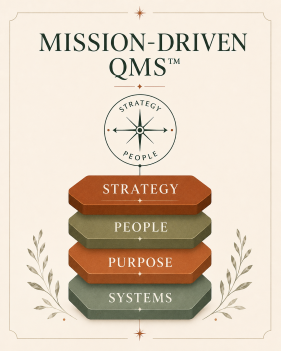
Those questions lead to a very different kind of quality system. Instead of building around compliance first, a Mission-Driven QMS builds around purpose, risk, ownership, and flow. It still meets requirements. It still creates evidence. It still supports audits. But compliance becomes evidence of a healthy system, not the reason the system exists.
In a Mission-Driven QMS, quality is not a separate agenda competing with delivery, engineering, manufacturing, or leadership. Quality becomes part of the organization’s operating model. It helps the business see clearly, make better decisions, reduce friction, and deliver with confidence.
That means the process exists for a reason. The documentation exists for a reason. The controls exist for a reason.
The system is not there to prove that quality is important; it is there to help important work happen more reliably.
A Better Starting Question
If your quality system feels heavy, disconnected, or adversarial, the answer may not be to throw it away. It may not even be to simplify everything immediately. The better starting point is to ask a different question.
Not, “What do we need to do for ISO?”
But, “What does our mission require from our system?”
What needs to be clear? What needs to be controlled? Where do people need better information? Where are we asking people to rely on memory? Where are problems being hidden because the process feels too painful? Where has documentation become detached from the actual work? Where is quality helping, and where is it unintentionally getting in the way?
Those questions lead to a QMS that is still compliant, still disciplined, and still auditable, but also useful.
Human. Strategic. Connected to the work.
That is the kind of quality system I believe in: quality that mixes business strategy, business operations, and systems thinking for real humans. Quality that helps people do excellent work without drowning them in unnecessary ceremony. Quality that respects the mission enough to build the structure needed to protect it.
Compliance Is the Floor, Not the Goal
None of this means compliance is unimportant.
Standards like ISO 9001 can be incredibly valuable. They give organizations a common language for process management, risk-based thinking, customer focus, leadership responsibility, competence, improvement, and evidence. A well-designed QMS should absolutely be able to stand up to an audit. But compliance is not the highest goal. Compliance is the floor.
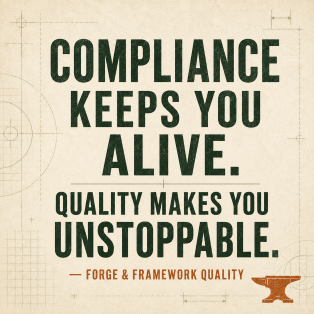
The real goal is a business that can deliver on its promises. A business that can grow without scaling chaos. A business where people know what is expected, have the tools they need, and can raise their hands when something is not working. A business where the product does not just pass inspection, but actually performs its intended function.
That is real quality.
Not paperwork quality. Not audit-day quality. Not “we technically followed the procedure” quality. Real quality shows up in the product, in the customer experience, in the confidence of the team, and in the organization’s ability to keep getting better.
That is what makes quality powerful: not because it controls the business, but because it helps the business become worthy of its mission.

If you are ready to start thinking about your quality system this way, my free 5-day course, QMS Strategy in a Week, is designed to help you take the first step toward a Mission-Driven QMS with clarity, simplicity, and purpose.