Effort Isn’t Inherently Valuable
I have a potentially unpopular opinion: Effort isn’t inherently valuable.
Hard work can absolutely be valuable. Some things are genuinely difficult, and sometimes the only way through them is persistence and a lot of effort. But work isn’t valuable because it is hard.

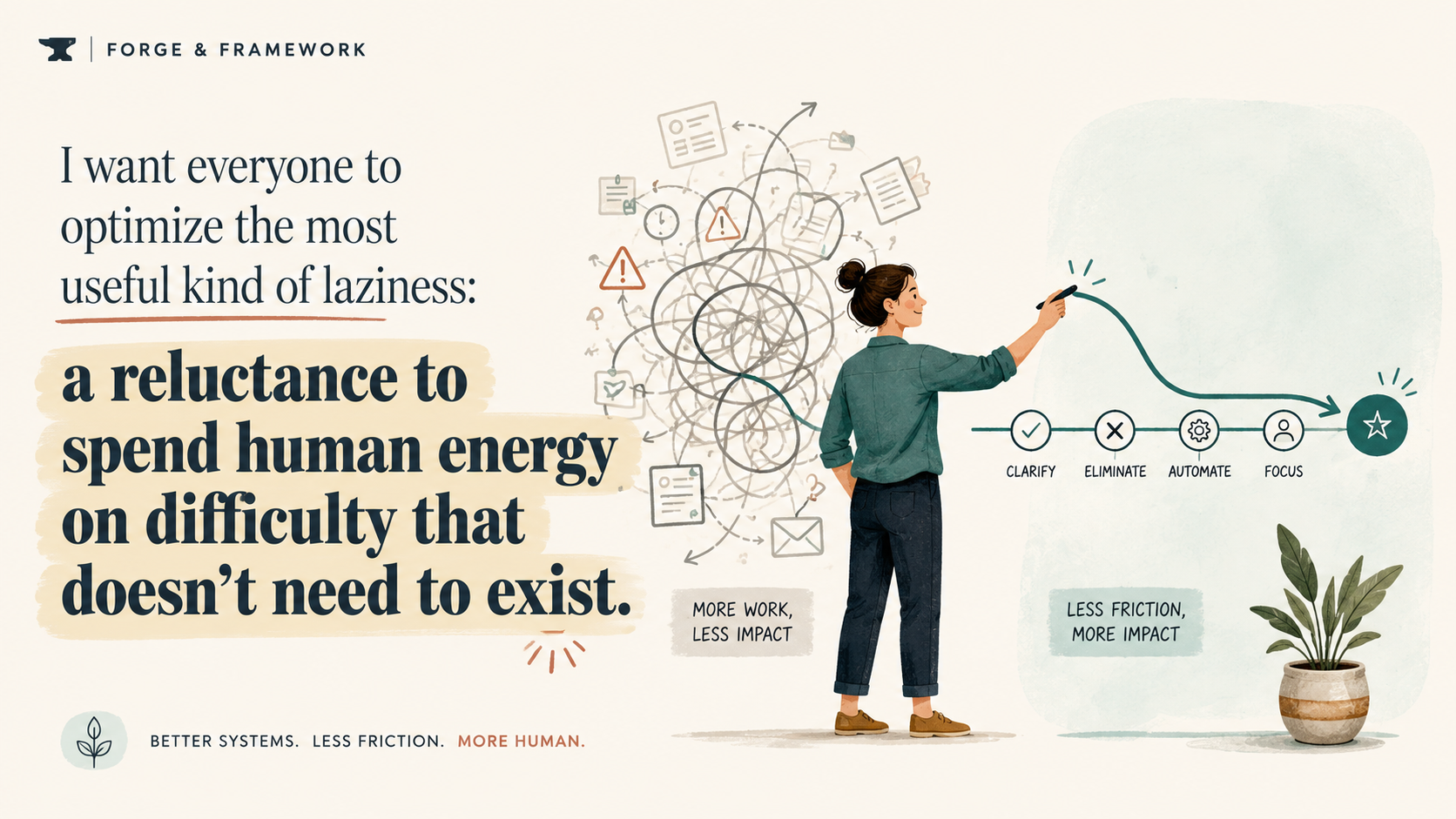
My dad used to give us the advice to “be lazy,” and to this this day I give that same advice to my employees (much to the horror of management). His version of laziness was basically: Do it right the first time so you don’t have to do it again. I want everyone to optimize the most useful kind of laziness: a reluctance to spend human energy on difficulty that doesn’t need to exist.
I think businesses could use more of that kind of laziness.
Before we get really good at doing something hard, it’s worth asking whether it needs to be hard in the first place.
This is partly why I like quality management
That sentence may have just lost a few readers.
Quality management has acquired a reputation for being concerned with procedures, audits, forms, signatures, certifications, and occasionally reminding everyone that they filled out Box 7 incorrectly. Those things can have a purpose - but they aren’t what interests me most about quality. At its best, quality management is really about understanding how work becomes results. A person puts energy into a system. They make a decision, turn a wrench, write some code…. something comes out the other side.
The interesting question is: How much of the energy they put in actually became the result they were trying to create?
Humans are adaptable. Give us a bad process and we’ll create a spreadsheet. Give us two systems that don’t talk to each other and someone will spend every Tuesday copying information between them. Eventually the workaround becomes part of the job, and everyone forgets the job wasn’t supposed to require it.
That’s why I think management systems have to be designed around real humans, not the imaginary ones who populate process diagrams. Real humans get interrupted. They make assumptions. They take shortcuts. They have six priorities and a meeting in eleven minutes.
A system that works beautifully only when everyone behaves perfectly is not a particularly good system.
The human isn’t an unfortunate complication in the process. The human is part of the system.
I want operating systems that help real people do good work reliably: enough structure to reduce chaos, but not so much that following the system becomes a second job. Systems that make problems visible, help organizations learn, and respect the fact that people have limited attention and energy.
The purpose of the system isn’t to have a beautiful system.
It’s to accomplish the mission.
Maybe that’s what I mean when I tell people to be lazy. I don’t want people to care less; I want the organization to waste less of their caring. I don’t want to eliminate hard work when hard work is necessary.
I just think we should be suspicious of work that is hard because nobody ever stopped to ask why.
There will always be genuinely difficult problems worth solving.
We should probably save our energy for those.